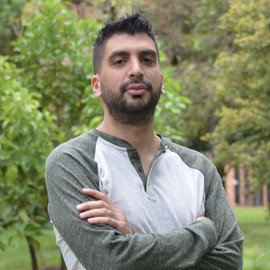
Welcome! I am an applied economist with research interests in the economics of development and political economy.
I am currently a Senior Researcher at the Education Evidence Lab at Colombia Evidencia Potencial en Educación (CEPE).
Previously, I was a Postdoctoral Research Fellow at the Department of Government at the University of Bergen, where I worked on the causes and consequences of conflict on women’s political and economic empowerment.
Before that, I was an Associate Professor at Pontificia Universidad Javeriana - Cali and Director of the Master in Social Policy at the same university.
As a PhD student, I was awarded the J. William Fulbright Foreign Scholarship and spent the 2019-2020 academic year as a Visiting Research Scholar at the Harris School of Public Policy at the University of Chicago. I was also a Research Consultant at The Empirical Studies of Conflict Project (ESOC) at Princeton University.
Work in progress:
Violence against women activists in Colombia reduces both women’s candidacies and voter support for female candidates in mayoral elections, driven by fear of retaliation and masculine political norms. Using novel data on activist killings, we show that these effects are mitigated by women’s visibility in peace processes and prior FARC control. Our findings highlight how the gender of victims shapes the political consequences of violence in conflict-affected democracies.
Poorly designed ceasefires can backfire. Studying the 2023 ceasefires decreed under Colombia’s Paz Total policy with a difference-in-differences design, we find that visible violence (homicides, terrorist attacks, massacres) was unaffected while less visible violence against civilians — extortion, forced recruitment of minors, and threats — rose substantially in municipalities with ceasefire group presence, consistent with strategic substitution by armed groups. A calibrated structural model implies that a roughly 50% increase in the detectability of less visible violence would be needed to fully offset these perverse effects, underscoring the need for credible monitoring and verification mechanisms.
Partial peace agreements can disrupt conflict power balances and spur renewed violence. Using a regression discontinuity design, I show that municipalities narrowly rejecting Colombia’s 2016 FARC peace referendum experienced a statistically significant rise in violence by non-state armed groups other than the FARC. I interpret the agreement as an economic shock that shifted incentives for violence among excluded armed actors. Consistent with this mechanism, the increase is strongest in areas with substantial coca cultivation and gold mining.
Daily sovereign bond prices drop by 0.7 points on average when state-involved conflict begins, based on event studies from the past two decades. A calibrated pricing model shows investors initially price only 14% of the shock but update quickly to 75% within 15 days, with larger reactions to severe violence near capitals and conflicts that directly threaten the state..
In-person: Winter 2026 (Undergraduate - Universidad ICESI)
Accessible explainers for causal inference methodology papers paired with runnable R code on simulated data.